AI vs Traditional Farming in Africa: What Works Best (2026)

🎥 Watch the Official Channel Trailer
See how Top AI Africa deploys production AI agents in 72 hours across the continent.
This Is Not a Competition
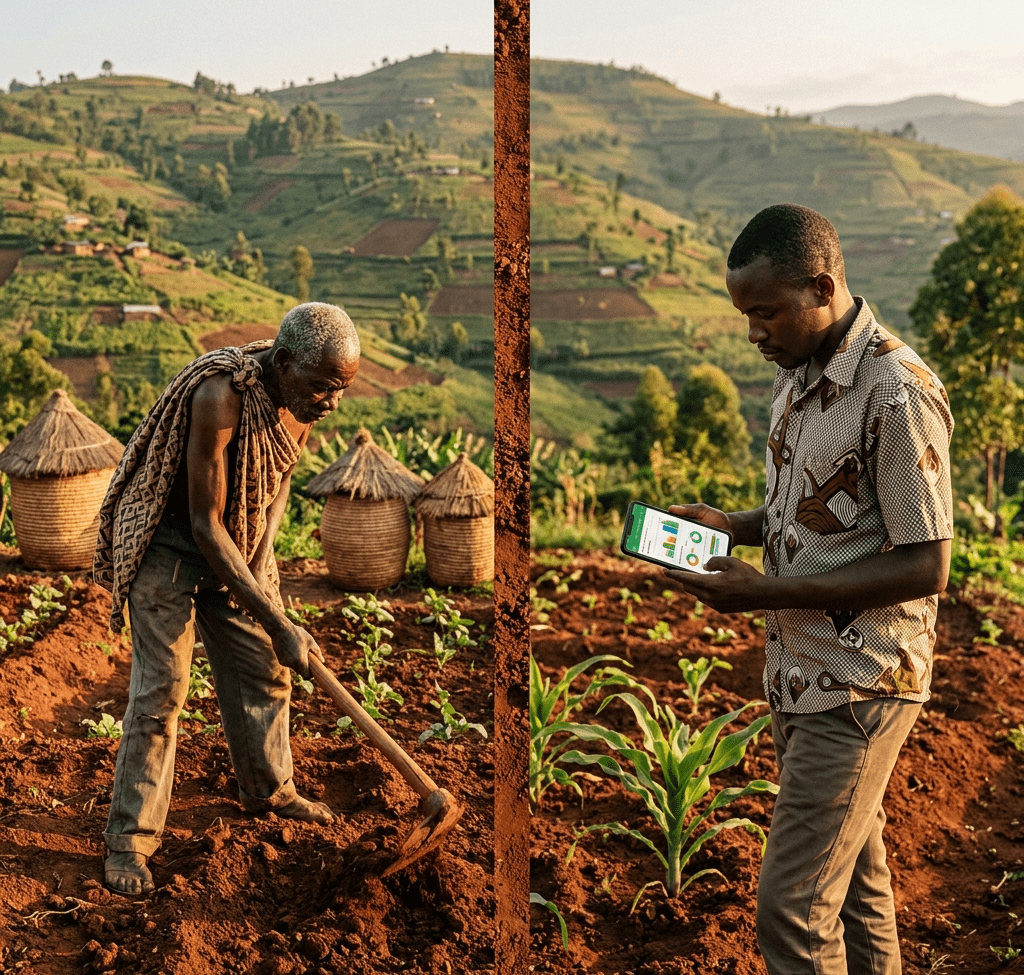
The debate between AI vs traditional farming in Africa often becomes a false choice. In 2026, neither approach alone delivers the best results for smallholder farmers across East Africa and Burundi. This honest comparison examines seven key factors — cost, accessibility, speed, accuracy, scalability, cultural fit, and resilience — to answer what actually works best for rural African agriculture. The evidence points to a clear winner: a hybrid approach that combines AI tools with traditional farming knowledge.
The real question is not “which is better?” The real question is: “What does each do well, and how do they work together?”
Understanding Both Approaches
What We Mean by Traditional Farming
Traditional farming in rural Africa is not primitive or random. It is a sophisticated system of knowledge built over centuries:
- Intercropping: Growing beans with maize to fix nitrogen naturally
- Seasonal indicators: Reading tree flowering patterns and insect behavior to predict rainfall
- Seed selection: Saving seeds from the strongest plants to improve crop resilience
- Soil management: Rotating crops, using compost, and fallowing plots
- Pest management: Companion planting, ash, and natural repellents
- Water management: Contour planting on hillsides, mulching to retain moisture
What We Mean by AI-Powered Farming
AI in African agriculture currently refers to crop disease detection using smartphone cameras, weather prediction using satellite data, market price information via SMS or WhatsApp, soil analysis using sensors and AI models, and planting recommendations based on data from similar farms.
AI farming tools do not replace physical farming. They provide information to help farmers make better decisions.
The Comparison: Seven Factors
1. Cost
Traditional farming knowledge: Free. It is inherited, shared within communities, and costs nothing to access.
AI tools: Most apps are free. But prerequisites include a smartphone ($17-50), phone charging ($0.10-0.30 per charge), and mobile data ($0.50-2.00/month).
Verdict: Traditional knowledge wins on pure cost. But the ROI for AI tools can be significant — a $17 phone that prevents a $200 crop loss pays for itself immediately.
2. Accessibility
Traditional knowledge: Available to anyone within the community. However, it can be lost when elders pass away without transmitting it.
AI tools: Requires a phone and sometimes mobile data. Currently accessible to approximately 40-60% of East African farmers.
Verdict: Traditional knowledge is more universally accessible today. AI accessibility is improving rapidly.
3. Speed of Information
Traditional knowledge: Slow to update. If climate patterns shift, it may take several seasons to recognize new patterns.
AI tools: Near-instant. A weather alert arrives before the storm. A disease diagnosis comes in 30 seconds.
Verdict: AI wins decisively on speed. In agriculture, timing often determines profit or loss.
4. Accuracy
Traditional knowledge: Highly accurate for stable, familiar conditions. Accuracy degrades when conditions change due to climate change or new pests.
AI tools: 70-95% accuracy depending on the tool and input quality. Can struggle with edge cases.
Verdict: Mixed. Traditional knowledge is more accurate for familiar conditions. AI is more accurate for novel threats. The combination is more accurate than either alone.
5. Scalability
Traditional knowledge: Does not scale easily. An extension worker can reach perhaps 500 farmers per year.
AI tools: A WhatsApp bot can serve 100,000 farmers simultaneously.
Verdict: AI wins on scalability. This is perhaps its greatest advantage in a continent with too few extension workers.
6. Cultural Fit
Traditional knowledge: Deeply embedded in cultural practices, social structures, and community identity.
AI tools: Can feel foreign or threatening to existing social structures. Younger farmers adopt more readily.
Verdict: Traditional farming has a significant cultural advantage. AI tools succeed best when introduced through existing trusted networks.
7. Resilience
Traditional knowledge: Resilient to technology failures. No batteries to die, no networks to crash.
AI tools: Vulnerable to dead batteries, network outages, and software bugs.
Verdict: Traditional knowledge wins on resilience. AI should supplement, not replace.
The Real Answer: A Hybrid Approach
The evidence from across East Africa consistently points to the same conclusion: the best outcomes occur when AI tools and traditional knowledge work together.
How the Hybrid Works in Practice
Planting Decisions: A farmer in Ngozi, Burundi uses traditional soil observation to plan her plot layout. She then checks the WhatsApp weather bot for a 7-day forecast before choosing her planting day. Traditional knowledge decides what and where. AI decides when.
Disease Management: A farmer notices unusual spots on his maize. Traditional knowledge tells him it could be fungal. He photographs the leaf and the WhatsApp crop diagnosis bot confirms: Gray Leaf Spot, 89% confidence. He applies the traditional remedy combined with the bot’s specific recommendation.
Market Timing: An elderly coffee farmer judges cherry ripeness by color, firmness, and taste. His grandson checks the AI market price tracker for the best buyer this week. Traditional quality knowledge meets AI market intelligence.
Productivity Comparison
| Approach | Avg Yield Improvement | Cost | Information Speed |
|---|---|---|---|
| Traditional knowledge only | Baseline | Free | Seasonal |
| AI tools only | +15-25% | $20-50/year | Instant |
| Hybrid (traditional + AI) | +30-50% | $20-50/year | Instant + deep local context |
What Organizations Should Do
- Never position AI as a replacement for traditional knowledge. Frame it as an additional tool.
- Involve community elders in the introduction of AI tools. Their endorsement matters more than any marketing.
- Train farmer-leaders who can bridge both worlds.
- Collect and digitize traditional knowledge where appropriate and with community consent.
- Design for failure gracefully. When the phone dies, farmers should fall back on traditional methods seamlessly.
For more on what AI tools are available, explore the AI tools available for East African farmers or learn about AI adoption in Burundi farming.
Looking Ahead: 2026 and Beyond
- AI models trained on African data will become more accurate and locally relevant
- Voice-based AI in local languages will make tools accessible to non-literate farmers
- Community-owned data — farmers contributing observations to improve AI models
- Government integration — national policies incorporating both traditional knowledge and AI
- Youth as bridges — young farmers who respect tradition but are comfortable with technology
Both, Not Either
The question “AI or traditional farming?” is the wrong question for rural Africa. The right question is: “How do we give every farmer access to both?”
Traditional knowledge provides the foundation — deep understanding of local conditions built over generations. AI provides the acceleration — instant access to information that was previously unavailable.
The farmer who has both is the farmer who thrives.
Ready to integrate AI tools with existing agricultural programs in Africa? Contact Top AI Africa to design hybrid solutions that respect traditional knowledge while deploying cutting-edge agentic AI technology.
🎥 New: Top AI Africa YouTube Channel
AI agent tutorials, case studies, and live deployment demos in English and French. Subscribe for new content every week.
Frequently Asked Questions
Is AI farming better than traditional farming in Africa?
Neither is universally better. Traditional farming provides deep local knowledge and costs nothing. AI provides speed, scalability, and access to new information. Research across East Africa shows that combining both approaches yields 30-50% better results than either alone.
Can traditional farmers learn to use AI tools?
Yes. AI farming tools in East Africa are designed for farmers with limited technology experience. Voice-based interfaces, WhatsApp bots, and SMS services require minimal technical skill. Studies show farmers of all ages can learn within one training session.
Will AI replace farmers in Africa?
No. AI in African agriculture provides information, not labor. It tells farmers what disease their crop has or what price they can get at market. The farming itself — planting, weeding, harvesting — remains human work.
How much does it cost to start using AI farming tools in East Africa?
The main cost is a basic smartphone ($17-50 USD). Most AI farming apps and WhatsApp bots are free. Monthly data costs for agricultural use are typically $0.50-2.00. The investment can pay for itself within one season.
What is the biggest challenge for AI farming in rural Africa?
Infrastructure — specifically electricity access and mobile network coverage in remote areas. In countries like Burundi, rural electricity access is below 5% in some provinces. Phone charging and network availability remain the primary barriers, followed by digital literacy and trust.
Latest Insights from Top AI Africa
- 📘 Pillar Guide: AI Agents Africa — The Complete 2026 Guide
- AI Revolutionizing Farming in Africa
- AI Helps Farmers Increase Yield 35%
- WhatsApp AI for Crop Disease Diagnosis
Ready to deploy AI? Book a free demo with Top AI Africa or explore our full services.