AI Farming in Burundi: The 2026 Smart Agriculture Guide


🎥 Watch the Official Channel Trailer
See how Top AI Africa deploys production AI agents in 72 hours across the continent.
A Quiet Revolution on Burundi’s Hills
Burundi is one of the most densely populated countries in Africa, with over 85% of its population depending on agriculture. In 2026, AI farming in Burundi is no longer a distant promise — it is a reality unfolding on the hillsides of Gitega, Ngozi, and Bubanza. Artificial intelligence is reaching smallholder farmers not through expensive hardware, but through the smartphones they already carry.
The average farm in Burundi is less than 0.5 hectares. Rainfall is increasingly unpredictable. Soil erosion strips the hillsides after every heavy rain. For decades, farmers have relied on generational knowledge, manual labor, and hope. But a new set of tools is changing the equation.
This guide explores how AI is transforming agriculture in Burundi, what tools are available today, and what challenges remain.
The State of Agriculture in Burundi
Why Farming in Burundi Is Uniquely Challenging
Burundi’s agricultural sector faces a combination of pressures that few other countries experience simultaneously:
- Land scarcity: With over 12 million people and only 27,830 km² of land, farm plots are shrinking with each generation
- Climate volatility: The rainy seasons (Umuhindo and Urugaryi) are becoming less predictable, with droughts and floods increasing since 2020
- Limited infrastructure: Fewer than 15% of rural roads are paved, making market access difficult
- Low mechanization: Over 90% of farming is done by hand
- Post-harvest losses: An estimated 30-40% of crops are lost after harvest due to poor storage
Despite these challenges, agriculture contributes approximately 40% of Burundi’s GDP. Coffee, tea, cassava, beans, and bananas remain the backbone of the economy.
The Digital Foundation
Mobile phone penetration in Burundi reached approximately 62% in 2025, with smartphone adoption growing rapidly thanks to affordable devices from Tecno, Itel, and Samsung. Mobile money services like Lumicash and Ecocash are widely used. This mobile infrastructure is the foundation on which AI agriculture tools are being built.
How AI Is Being Used on Burundian Farms Today
Crop Disease Detection via Smartphone
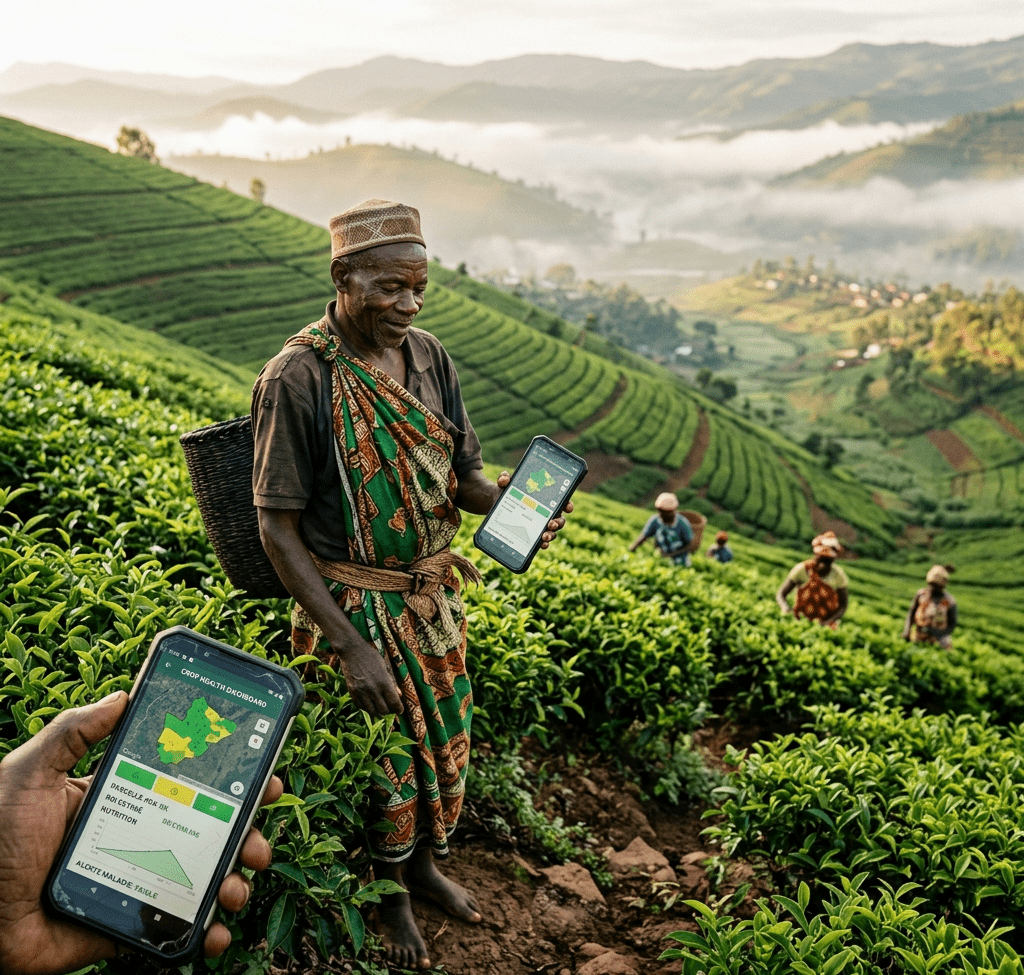
The most immediate and visible application of AI in Burundi’s agriculture is crop disease detection. Farmers can now photograph a diseased leaf with their phone and receive a diagnosis within seconds.
Tools like PlantVillage Nuru (developed by Penn State University) work offline on Android phones. The app uses a trained neural network to identify diseases in cassava, maize, and potato — three of Burundi’s most critical food crops.
A farmer in Kayanza province who notices yellowing leaves on her cassava plants no longer has to wait weeks for an extension worker to visit. She opens the app, takes a photo, and receives a diagnosis: Cassava Mosaic Disease. The app recommends removing infected plants and sourcing resistant varieties from the nearest ISABU (Institut des Sciences Agronomiques du Burundi) station.
This is not futuristic. This is happening now.
Weather Prediction and Advisory Services
Traditional weather knowledge — reading cloud patterns, observing insect behavior — served Burundian farmers for centuries. But climate change has disrupted these patterns.
AI-powered weather advisory services now deliver hyperlocal forecasts via SMS and WhatsApp. These services analyze satellite imagery, ground sensor data, and historical weather patterns to generate 7-day forecasts tailored to specific communes.
For a farmer deciding when to plant beans in Muyinga province, receiving an SMS that says “Heavy rain expected in 3 days — delay planting by 48 hours” can mean the difference between a successful crop and seeds washed down the hillside.
Market Price Intelligence
One of the most exploitative dynamics in Burundian agriculture is information asymmetry. Middlemen often purchase crops from rural farmers at 40-60% below market value because farmers simply do not know the current prices in Bujumbura’s markets.
AI-powered market information systems aggregate price data from urban markets and deliver it to farmers via SMS in Kirundi. When a coffee farmer in Ngozi knows that the price per kilogram in Bujumbura is 4,500 BIF instead of the 2,800 BIF the middleman is offering, that knowledge is power.
Soil Analysis and Fertilizer Recommendations
Several pilot programs in East Africa are using AI to analyze soil data and recommend precise fertilizer applications. Instead of blanket applications of NPK fertilizer (which is expensive and often misused), AI systems can recommend specific nutrient combinations based on soil samples, crop type, and local conditions.
Organizations like the International Fertilizer Development Center (IFDC) have been working in Burundi to combine soil mapping data with AI recommendation engines. The goal is to help farmers use less fertilizer more effectively — reducing costs and environmental damage simultaneously.
The Mobile-First Approach: Why It Works in Burundi
SMS and USSD-Based AI
Not every farmer has a smartphone. Not every smartphone has reliable internet. This is why the most successful AI agriculture tools in Burundi operate through SMS and USSD codes.
A farmer can dial a short code, enter their location and crop type, and receive AI-generated advice as a text message. No app download required. No internet connection needed. No literacy in a second language required — the services operate in Kirundi and French.
WhatsApp as an AI Interface
For farmers with smartphones and basic data access, WhatsApp has become an unexpected AI platform. Agricultural advisory chatbots on WhatsApp allow farmers to send photos of diseased crops and receive diagnoses, ask questions in voice notes, receive weekly weather and market updates, and connect with agricultural extension workers.
The conversational nature of WhatsApp makes AI feel less like technology and more like advice from a knowledgeable neighbor. Learn more about WhatsApp AI crop diagnosis bots in our detailed guide.
Voice-Based AI
In a country where adult literacy rates hover around 68%, voice-based AI tools are essential. Several initiatives in East Africa are developing Interactive Voice Response (IVR) systems where farmers call a phone number, listen to menu options in their local language, and receive AI-generated agricultural advice spoken aloud.
This approach respects the oral traditions of Burundian culture while delivering cutting-edge technology.
Challenges and Limitations
Infrastructure Gaps
Despite progress, electricity access in rural Burundi remains below 5% in many provinces. Phone charging is often done at small solar kiosks or market-day charging stations. AI tools must be designed to work on low-battery, low-storage devices.
Data Scarcity
AI models are only as good as their training data. There is a significant shortage of labeled agricultural data specific to Burundi — local crop varieties, local disease strains, local soil types. Models trained primarily on data from Kenya or Nigeria may not perform accurately on Burundian farms.
Trust and Adoption
Many farmers are understandably skeptical of advice from a machine. Building trust requires demonstration, word of mouth, and integration with existing trusted networks like cooperatives and church groups.
The Road Ahead: 2026 and Beyond
The trajectory is clear. As smartphone prices continue to fall, mobile networks expand, and AI models improve with more local data, the technology will become more accurate and more accessible.
Key developments to watch in Burundi:
- Government integration: The Burundian Ministry of Agriculture is exploring partnerships with AI providers for national extension services
- Cooperative-led adoption: Agricultural cooperatives are becoming distribution channels for AI tools, training farmer-leaders who then train others
- Youth engagement: Young Burundians returning from tech training in Kigali and Nairobi are building locally-relevant agricultural AI solutions
- Drone technology: Early pilot programs are testing drone-based crop monitoring in Imbo plain rice paddies
For a broader look at top AI tools for East African farmers, see our companion guide. You may also want to understand how AI compares to traditional farming in the African context.
Technology That Serves the Farmer
AI in Burundian agriculture is not about replacing farmers. It is about giving them information they have never had access to before — information about their soil, their crops, their weather, and their markets.
The most successful AI tools are those that respect the farmer’s reality: limited connectivity, limited literacy, limited budgets, but unlimited determination.
For organizations, NGOs, and technology providers looking to make a real impact in Burundi’s agricultural sector, the opportunity is enormous. The foundation is mobile. The interface is simple. The need is urgent.
Ready to explore how AI can support agricultural development in Burundi? Contact Top AI Africa for a free consultation on deploying mobile-first AI automation services for Africa.
🎥 New: Top AI Africa YouTube Channel
AI agent tutorials, case studies, and live deployment demos in English and French. Subscribe for new content every week.
Frequently Asked Questions
Can AI farming tools work without internet in Burundi?
Yes. Several AI tools like PlantVillage Nuru work completely offline on Android phones. SMS and USSD-based services also require no internet connection, only basic mobile network coverage.
What crops can AI diagnose diseases for in Burundi?
Current AI tools can diagnose diseases in cassava, maize, potato, banana, and bean crops. Models are being expanded to include coffee and tea — two of Burundi’s most important cash crops.
How much does it cost for a farmer to use AI tools in Burundi?
Most AI agriculture apps are free to download. SMS-based services typically cost 50-100 BIF per query (less than $0.02 USD). The main cost barrier is owning a smartphone, which starts at approximately 50,000 BIF ($17 USD) for basic Android models.
Is AI replacing agricultural extension workers in Burundi?
No. AI is supplementing extension workers, not replacing them. Burundi has approximately 1 extension worker per 5,000 farmers — AI helps bridge this gap by providing instant advice between human visits.
What language do AI farming tools use in Burundi?
Most tools operate in French, with an increasing number offering Kirundi language support. Voice-based systems and WhatsApp bots are particularly effective for Kirundi-speaking farmers with limited literacy.
Latest Insights from Top AI Africa
- 📘 Pillar Guide: AI Agents Africa — The Complete 2026 Guide
- AI Revolutionizing Farming in Africa
- AI Helps Farmers Increase Yield 35%
- WhatsApp AI for Crop Disease Diagnosis
Ready to deploy AI? Book a free demo with Top AI Africa or explore our full services.